|
Victory is Dactylic, Which is Amphibrachic |
|
|
|
Many classic poetic works were written in iambic pentameter. The word pentameter means that each line consists of five “feet”, and the word iambic means that each foot consists of an unstressed syllable (0) and a stressed syllable (1). Thus each line has the form 01 01 01 01 01. For example, the line “The weight of this sad time we must obey” is in iambic pentameter. The complement of the iambic is called the trochaic, in which each foot has the form 10. |
|
|
|
It’s often said that iambic pentameter is the most natural sounding pattern for verse in the English language, but a variety of other patterns are used as well. For example, in the dactylic form, each foot has three syllables with the accent pattern 100. This was famously used in Homer’s Illiad and Odyssey. In the anapestic form (sometimes called antidactylic), each foot has the pattern 001. In the amphibrachic form, each foot has the pattern 010. |
|
|
|
One fairly well-known metrical form is anapestic tetrameter, in which each line consists of four feet of the anapestic form. Thus each line has the form 001 001 001 001. An example of this is “Twas the night before Christmas and all through the house”. This particular meter seems to be associated with light-hearted or even comical verse, and was used extensively by (for example) the children’s book author Dr. Seuss. Sometimes a syllable is dropped or added to the beginning or ending of a line. Dropping an unstressed syllable from the beginning of a line is called acephalexis. The following little bit of comical verse, found on the internet, is in anapestic tetrameter with acephalexis (reproduced with permission): |
|
|
|
Recursive Chad |
|
Oh handsome, athletic, adorable Chad, |
|
The rizzliest charmer the school ever had. |
|
When he was a senior, a definite ten, |
|
He was the most datable boy about town. |
|
The next year, when he was a senior again, |
|
He naturally re-won the homecoming crown. |
|
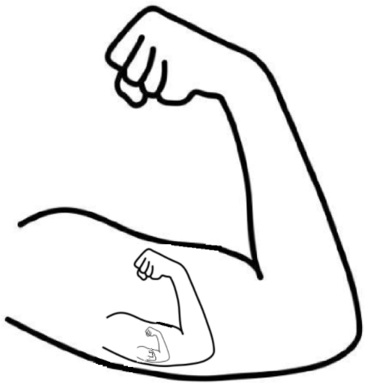
He got a tattoo of his face to festoon |
|
His shoulder with all of his good looking charm, |
|
And then in a move that made all the girls swoon |
|
He got a tattoo of his arm on his arm. |
|
But he became troubled, it just wouldn’t do, |
|
The arm on his arm didn’t have a tattoo. |
|
So back to the parlor he went to re-group, |
|
And found himself trapped in an infinite loop. |
|
|
|
|
|
|
|
Another illustrative bit of comical verse is based on what may best be described as amphibrachic tetrameter (reproduced with permission): |
|
|
|
The Professor’s Reckoning |
|
Our business Professor was such a bad sinner, |
|
She had a most cunning and mean spirit in her. |
|
She preyed on a student in one of her classes |
|
And tried to seduce him with improper passes. |
|
She tampered with cell phones and meanly coerced, |
|
In tricks and conniving was clearly well-versed. |
|
He finally fought back, had her sent off to jail, |
|
But she lawyered up and was soon out on bail. |
|
She re-turned the tables, left him in a daze, |
|
And smugly resumed her nefarious ways. |
|
When after a lifetime of crime the day came |
|
For meeting her maker, she still had no shame. |
|
The angels in heaven all tried to defeat her |
|
And yet she gained entry, she blackmailed St Peter. |
|
|
|
The classifications of metrical forms has some ambiguity (like musical notes, where C sharp is also D flat), especially since syllables can be appended or omitted at the start or end of a line, because some forms are equivalent up to rotations of the bits. Also, poetic lines sometimes have mixtures of different kinds of feet, so we might just characterize the meter of a given line, allowing for accidentals, by the binary form of the entire line. |
|
|
|
Among the 2-bit forms are also the trochaic (11) and the pyrrhic (00), but expressions with multiple consecutive stressed bits (“turn turn turn”) seem to be somewhat anomalous in language, and a form consisting solely of unstressed bits is rather reductionist, and could just as well be assigned the 1-bit meter 0. (In this sense a “Pyrrhic victory” is an oxymoron, since “victory” is dactylic.) Excluding the pure 0 forms, and any forms that would give two stressed consecutive bits, the only viable binary bi-feet are 01 and 10, and the only viable tri-feet are 001, 010, and 100. As noted above, these are just rotations of each other. In Morse code, used in old-fashioned telegraphy, the bi-feet are A and N, and the tri-feet are U, R, and D. There are also verses that make use of 4-bit feet, such as the Beethoven V foot, 0001. For example, the following bit of juvenile doggerel has lines consisting of a single iamb, 01, followed by two V feet, 0001 (reproduced with permission): |
|
|
|
Distraction |
|
This mean girl would monopolize the class |
|
And says I’m too distracting for her taste. |
|
She thinks I must be cheating to surpass |
|
Her grade point average, but her ire’s misplaced. |
|
I’m genuinely smart, as she will learn, |
|
And like to think I’m cute enough for math. |
|
While hunting for good will hope springs etern- |
|
al, but will she be Dickinson or Plath? |
|
Should I be drawn in by her prettiness |
|
Or maybe make a break for it and flee? |
|
Just what is this girl up to? I confess |
|
Her purpose is inscrutable to me. |
|
Regardless of her plan she is quite hot, |
|
And definitely my attention’s got. |
|
|
|
It might be possible to embed a message with Morse code into ordinary-looking text, using the emphasis patterns of the syllables, although there would be ambiguities without some means of demarking the characters, and also ambiguities due to potential differences in how people read the patterns of emphasis. Recall the importance in the movie “The Conversation” of the distinction between the overheard statement “He’d kill us if he had the chance” versus “He’d kill us if he had the chance”. Another interesting fact raised by these examples is how important the cadence and patterns of emphasis are for achieving the effect of rhyme. Even for lines with the same number of syllables, ending with exact rhymes, those rhymes will be almost imperceptible without a matching pattern of stresses. On the other hand, some variations in patterns is necessary to avoid monotony. |
|
|
|
Lastly, the mock-Shakespearean lines below (reproduced by permission) are an example of what can probably be called genuine iambic pentameter: |
|
|
|
Pronouns and Proverbs |
|
If nakedly your girlfriend isn’t sure |
|
About your gender, well, that’s not so good. |
|
Though confident my darling is a Her, |
|
She doubteth me. I’m sore misunderstood. |
|
I open jars, explain things, reach high shelves, |
|
Lack fashion sense, think logically, watch games, |
|
But struggle to identify ourselves, |
|
Confused by ambiguity of names. |
|
If, when in bed, your passions I can’t stir, |
|
There’ll be no other causes to condemn. |
|
Sans sonographic proof for she or her |
|
There seems to be no hope for they or them. |
|
Let not these obfuscations us commit |
|
Lest pronouns spell the end of her and it. |
|
|
|
Some of these lines could be scanned as AVV rather than AAAAA, but in context the iambic pentameter reading seems justified. |
|
|